Benjamin Franklin K-8 Center, Algebra I E.O.C.

Algebra & Math Education
Rewriting
rational expressions

Watch and complete your notes on the videos below.
Afterwards, read about Rewriting Rational Expressions. Then, test your knowledge!
Multiplying Polynomials
To multiply two polynomials:
-
multiply each term in one polynomial by each term in the other polynomial
-
add those answers together, and simplify if needed
Let us look at the simplest cases first.
1 term × 1 term (monomial times monomial)
To multiply one term by another term, first multiply the constants, then multiply each variable together and combine the result, like this (press play):
(Note: I used "·" to mean multiply. In Algebra we don't like to use "×" because it looks too much like the letter "x")
1 term × 2 terms (monomial times binomial)
Multiply the single term by each of the two terms, like this:
2 term × 1 terms (binomial times monomial)
Multiply each of the two terms by the single term, like this:
(That was a bit faster because you can use mental math before writing it down.)
2 terms × 2 terms (binomial times binomial)
Each of the two terms in the first binomial ...
... is multiplied by ...
... each of the two terms in the second binomial
That is 4 different multiplications ... Why?

It is the same when we multiply binomials!
Instead of Alice and Betty, let's just use a and b, and Charles and David can be c and d:
We can multiply them in any order so long as each of the first two terms gets multiplied by each of the second two terms.
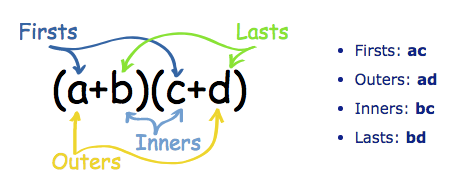
But there is a handy way to help us remember to multiply each term called "FOIL".
It stands for "Firsts, Outers, Inners, Lasts":
So you multiply the "Firsts" (the first terms of both polynomials), then the "Outers", etc.
Let us try this on a more complicated example:
2 terms × 3 terms (binomial times trinomial)
"FOIL" won't work here, because there are more terms now. But just remember:
Multiply each term in the first polynomial by each term in the second polynomial.
Like Terms
And always remember to add Like Terms: